
The Road to the Bountiful Life: Why Your Agency’s Growth Requires a New Purpose?
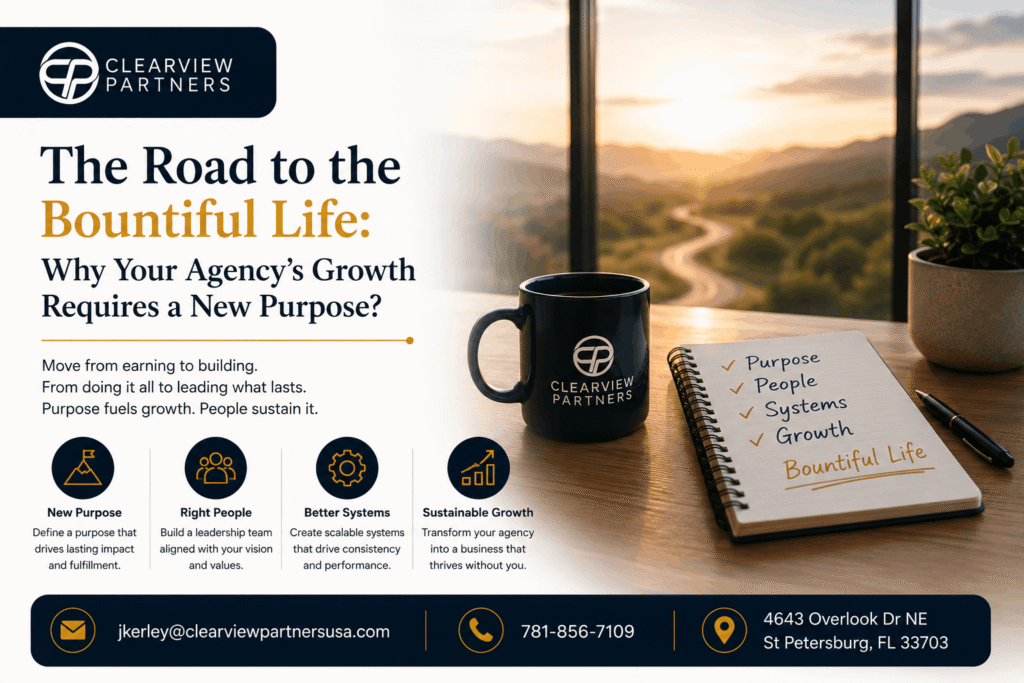
The First Million Is an Achievement. It’s Also a Test. They say the first million is the hardest. In my experience, it’s also the most deceptive. If you’ve reached it, you’ve earned the right to feel proud. You built something real. You proved you could sell, lead, deliver, and adapt—often all at once. You were the rainmaker, the relationship holder, the problem solver, and the safety net. And yet, if you’re honest, you may feel a quiet tension beneath the success. Because what got you here is now quietly holding you back. At Clearview Partners, we call this the First Million Trap—a stage where success was built on individual effort, but growth now requires something fundamentally different. The business that once rewarded your heroics is now dependent on them. And that dependency becomes a ceiling. This is not a failure of ambition. It’s a sign you’ve reached a new chapter. The Loneliness of Being the Hero Million-dollar agency leaders rarely talk about this part out loud. The truth is, being the hero can be lonely. Everyone looks to you for answers. Decisions bottleneck at your desk. Clients want you. The team waits for your approval—even when you wish they wouldn’t. You may even tell yourself, “Once things calm down, I’ll work on the business.” But somehow, they never do. This is where many leaders plateau—not because they lack desire, but because desire alone doesn’t build scalable organizations. And that distinction matters. Desire Is Wanting. Purpose Is Fuel. Harry Hoopis, in his timeless book The Road to the Bountiful Life, offers a perspective that aligns deeply with what I see every day in strategic growth work. Desire is simply wanting something to happen. Purpose is the driving reason behind action. Hoopis defines purpose as “the objective one strives for,” and he reminds us that purpose must provide the fuel necessary for extraordinary performance. But here’s the part most people miss: extraordinary success doesn’t come from extraordinary acts. It comes from extraordinary ones. Doing ordinary things—strategy, hiring, coaching, accountability—with more consistency, more discipline, and more intention than anyone else. That’s where transformation lives. “Your purpose has to provide the fuel necessary for extraordinary performance… only the extra in ordinary will help you get what you want out of life.” – Harry Hoopis The Real Pivot: From Earning to Building At the first million, the unspoken question shifts. It’s no longer just: “How much more can I earn?” It becomes: “What am I building—and why does it matter?” This is where purpose matures. To scale, your role must change. You move from being the primary producer to becoming the architect of people, systems, and culture. You are no longer in the business of selling services—you are in the business of building an organization that can sell, deliver, and grow without your constant intervention. This shift is the heart of Business Transformation Services. It’s not about working harder. It’s about reimagining what you’re building, why you’re building it, and—with intention—with whom. The “With Whom” Factor: Growth Is a Team Sport You cannot build a multi-million-dollar agency alone. And you cannot do it with a team designed merely to support you. This is where many leaders get stuck. Early hires are often helpers—good people who execute tasks but don’t own outcomes. That model works when you’re small. It fails when you’re scaling. Strategic growth requires leaders at every level. At Clearview Partners, our Business Strategy Consulting Services focus heavily on the With Whom question: Who can lead when you’re not in the room? Who thinks in systems, not just tasks? Who is aligned not only with goals, but with purpose? This is where Leadership and Management Coaching becomes essential. Most founders were never trained to build leadership teams. They were trained—by necessity—to do everything themselves. Letting go isn’t a skills issue. It’s a mindset shift. The Emotional Work of Letting Go Delegation isn’t hard because others are incapable. It’s hard because your identity is tied to being indispensable. This is where Executive Leadership Coaching and the role of a Confidence and Mindset Coach come into play. Scaling forces leaders to confront deeply ingrained beliefs: If I don’t touch it, it won’t be right. No one will care as much as I do. If I step back, I lose relevance. These beliefs once kept you alive as a founder. But at scale, they quietly suffocate growth. Purpose helps you release them. From Informal Habits to Intentional Systems Desire says, “We should really systematize this.” Purpose says, “We will—and here’s how.” This is the moment where Business Transformation Services become tangible. Transformation begins with an honest audit: How decisions are made. Where authority lives. How leaders are developed. Where the founder is still the bottleneck. From there, we replace heroic effort with repeatable systems—so performance doesn’t depend on your presence in every meeting, deal, or crisis. This isn’t about complexity. It’s about clarity. Ordinary Habits, Extraordinary Results Harry Hoopis reminds us that a well-defined purpose drives good habits. In practice, that means leaders who scale successfully commit to habits that feel unglamorous but compound over time: Investing in leadership before it feels comfortable Building culture as infrastructure, not decoration Holding clear accountability without micromanaging Making strategic decisions that serve the long game These are ordinary actions. They just require extra commitment. And that commitment is what separates wishing from doing. YOU CAN DO IT! The Bountiful Agency A bountiful life isn’t about excess. It’s about alignment—between values, actions, and outcomes. A bountiful agency is one where: Growth does not require burnout Leadership is shared, not hoarded Systems support freedom, not control The founder’s purpose expands rather than constricts This is what becomes possible when you stop trying to be the hero—and start becoming the builder. As I often remind clients: “Your purpose is the guidepost of your future success. If your goal is to lead a multi-million-dollar agency, you are no longer in the business of selling products; you are in the business of building people
Why Every High-Performer Requires Executive and Professional Coaching?

You might be in the best shape of your life—sharp, determined, and motivated—and still have episodes of being at a loss. It could be that your accomplishment does not quite give you the same satisfaction as before, or the demand for you to produce is increasing, and you are unable to think calmly. In such a situation, executive and professional coaching becomes essential instead of a luxury. For no matter how good you are, there is always a next level of understanding self-assurance, and that means that you can reach. The Unspoken Struggles of High-Performers High-performers are the ones who, as a rule, live a dynamic life—being constantly on the move, raising the limits, and solving the problems while pushing the others to follow, even going so far as to lead the charge. But all that speed comes with a cost in the form of exhaustion, uncertainty, self-questioning, and the like, which are seldom acknowledged. The matter is not of putting in more effort; rather, it is about working with clear purpose and self-awareness. It is at this junction that executive and professional coaching comes into play—not as a way to fix the problematic, but as a means to fine-tune what is operating well. Coaches help in clarifying the gaps in perception, changing the way of thinking, and reinforcing the ability to make choices. It is not treatment, nor is it managerial advice. It is a kind of playing with ideas differently—a process of synchronizing your personal vision with your professional objectives. Why Even Top Leaders Seek Guidance? Leadership is solitary. The more you rise in the hierarchy, the fewer people you will have available to find out the truth and get opinions without hiding behind the walls of niceness. A perfectly capable leader of a team could still be in need of a personal mentor for his or her driver of development as a leader. This is exactly the place where executive leadership coaching arrives. It is a mirror that shows not only the bright sides of a person’s leadership but also the dark sides that are sometimes the reason why a person leads, communicates, and affects others in a certain way. It does not mean that the person’s character or personality is changing, but rather that his or her leadership presence is being polished to the extent that what he or she does matches the person’s intent. When you are at the top, leading teams, mending the fences of the organization, or defusing conflicts, it is very easy to just go with your gut feeling.. Coaching pushes that gut thinking—encouraging you to challenge assumptions and develop strategies that really work in dynamic, fast-changing environments. Growth Beyond Skills and Titles It eventually comes to a point where having prerequisites of technical skills no longer makes one stand out. You are already aware of how to manage, strategize, and bring about changes positively. The next step is fortitude—how you perform when the odds are against you, and how long you continue to perform at a high level. Executive and professional coaching are meant for that kind of development. It is the knowledge of how your thoughts establish your conduct and how your conduct influences others. If you understand what your behavioral patterns are, you then have the power to consciously change them. That’s why leaders are no longer in a position of merely reacting to situations; instead, they are the ones who create. Coaching enables one to rise above the chaos, revitalize one’s connection with the core values, and then pick the options that are good for one’s ambitions as well as one’s wellness. The Shift from Doing to Leading Most professionals reach a plateau where “more” does not equal results anymore. You can’t work yourself out of complexity—you must work it out. Moving from being a high-performing individual to a great leader involves a different mindset, one that focuses on influence, empathy, and clarity. This is where coaching comes in. The right coach assists in translating your knowledge into leadership influence. You begin noticing how you make an impact on your team, the way communication resonates, and how your decisions shape organizational culture. When you cease hunting productivity and begin building perspective, you not only do better—you lead better. That’s the subtle change that coaching brings: you no longer manage tasks but motivate results. Actual Conversations That Inspire Change Coaching sessions are not motivational monologues or scripted advice. These are genuine dialogues that put assumptions into doubt, test new thoughts, and produce deep understanding, which might be unnoticed by you. A skilled coach hears what is not said—he picks up what you don’t say and helps you to tell the truth about what matters. It is a matter of getting to the core of the issue—not adding any more to your plate but rather removing mental distractions so you can have a little look at what really matters. It is precisely the mix of these discussions that gives rise to a new kind of trust; a trust built on transparency rather than authority. You are given the chance through executive leadership coaching to stop and think before making a move, to clarify your doubts before proceeding, and to convey your message purposefully. The result is not a louder leadership but rather a more purposeful one. Why Self-Awareness Is the Actual Competitive Advantage? In high-speed industries, mastery of technique goes stale fast. Emotional intelligence—being aware of and understanding one’s own and others’ feelings—is the one that always stays in style. Coaching is the process through which that knowledge is developed, and it helps leaders become aware of their triggers, manage their stress, and not lose their cool when things are going crazy. That self-knowledge fosters trust and authenticity, two characteristics every high-achieving leader must maintain to have power. Because in today’s leadership, individuals don’t merely follow titles—they follow energy, clarity, and integrity. Understanding what motivates you and what discourages you enables you to make wiser decisions, set better limits,
Improve Productivity and Participation Through Corporate Leadership Coaching
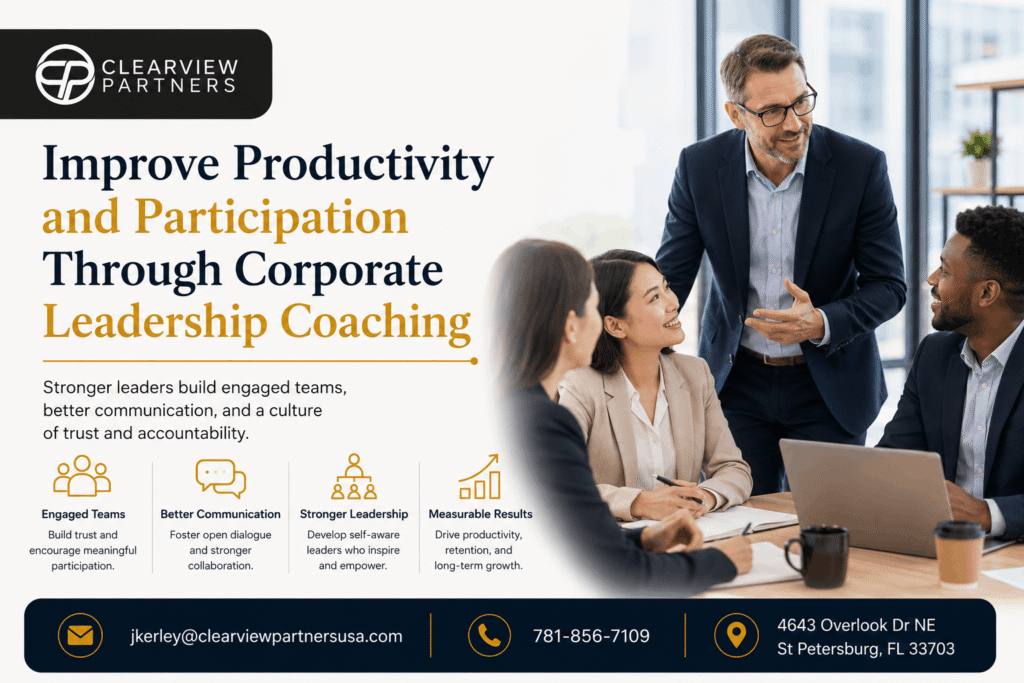
One can easily feel the atmosphere created by a group working with purpose, all the time. Meetings pass quickly, the participants are having fun, and no one is there simply because he/she has to be. Nevertheless, bringing a team to such a desirable state is not a matter of luck; it requires the right conditions, responsibility, and supportive leadership, which is much different from dictatorial control. This is the point where corporate leadership coaching for leaders appears—not as yet another corporate “trend,” but rather as a truly effective way for leaders to change their thought, communication, and connection patterns. Rethinking Leadership: It’s Not About Titles Anymore Modern-day offices are no longer the same as before in the sense that they do not respond to the power in authority. The predominant demand of the employees nowadays is not commands from the top but rather openness, fairness, and opportunities for growth. Corporate coaching for executive development of leaders with the skills to lead honestly and with emotional intelligence helps them to do away with the classical hierarchies. Trust gets built naturally when, and it’s that trust that people then remain engaged with the work and the cause. Coaching has the effect of refining that sensitivity, thereby changing decision-making and the circulation of information in the company. The Human Side of Corporate Performance Leadership is not merely a case of results—it is about human beings. A corporate executive coach for executive management reveals the very essence of an organization: involvement, aspiration, and drive. Incompetent or slow workers are the people managers usually blame for problems related to output, when, in fact, most times, it is emotional disconnection that causes such problems. In the case of employees believing that their voices do not matter or that they are not seen, they will not give their best. The training mentioned above equips the leaders with the necessary skills for listening to the strategies for resolving conflicts and the methods for providing feedback that connect those emotional gaps. The intention is not to make leaders “nicer”—it’s to make them conscious of the effect their words and actions have. It’s the human element that frequently distinguishes successful organizations from those that are constantly fighting fires. Leadership coaching leverages that reality and aligns individuals with purpose rather than pressure. Why Leadership Coaching Does Not Feel Like Traditional Training? Traditional leadership courses burden attendees with theories, models, and templates. They sound wonderful in the boardroom, but never make it out of the pressure of the real world. Coaching turns that model around—it’s experiential, interactive, and rooted in reality. Rather than trite advice, leaders work through actual problems in the moment. Whether it’s resolving conflict, reprioritizing, or clarifying communication, coaching converts insight to real-time action. The feedback loop is quicker and more powerful, enabling leaders to practice awareness rather than memorize leadership buzzwords. The distinction is presence. Coaching does not provide a binder; it shows you how to interpret the ambiance. Building Areas Where Teams Really Want to Stay A great deal can be inferred about a corporation through observing the employees’ reaction to a superior’s entrance. Are they at ease and intent on working, or have they suddenly stopped talking and turned cautious? Leadership sets the tone, and coaching teaches how to create an environment where creativity feels safe. By way of corporate leadership coaching, executives are taught to walk the tight rope between guiding and letting go. The notion isn’t to abandon control—ultimately, it’s to move away from directing and toward partnering. When individuals believe their contributions are heard, they invest in what they do. This kind of engagement is not something that is coerced; it’s created through trust and an authentic bond. As the contagion effect begins to take place, things just get easier. Work becomes less strained, the conversation is easier to come by, and that unspoken, agreed-upon feeling of shared purpose begins to settle in. Coaching helps leaders to facilitate this kind of atmosphere, intentionally, not by accident. Leadership is a Conversation, Not Command The world’s best leaders are the ones who do not own the meetings. They own the process. They can tell when to speak their mind and, more importantly, when to remain silent. Coaching builds that conversational intelligence by teaching the leaders to lead the conversation with accuracy and movement forward without cutting off others. Typically, a business executive coaching will include functional activities, such as how to ask the right questions that generate candid feedback, manage challenging conversations without a defensive posture, or delegate effectively. These are small but mighty shifts. When the mode of communication is via dialogue, rather than a directive, people naturally become more engaged. People cease performing for approval and begin contributing with intent. Molding Leadership to Meet the Modern-Day Problems The business environment is changing at a fast pace. Leaders are faced with the greatest challenges ever because of hybrid teams, virtual collaboration, and shifting demands from staff. The universal approach is no longer valid. Mentoring allows the supervisors to grow—their thinking becomes more strategic; at the same time, their human side is not lost. This flexibility is then essential when leading in uncertainty. Rather than responding to issues, coached leaders learn how to expect them, respond thoughtfully, and walk teams through change with clarity. That steadiness seeps down, cutting anxiety and increasing focus throughout the organization. In an era when burnout and disengagement are ongoing risks, coaching provides an avenue forward—one that intersects competence with compassion. Measuring What Really Matters Leadership coaching isn’t about theorizing; it’s all about the reality of results. Better retention, higher morale, and improved teamwork are not casual occurrences—they are the visible signs of leadership habit transformation. But the deeper change sometimes remains hidden, in daily interactions that slowly and gently transform the culture. The moment the managers are more self-aware, their teams will be self-aware as well. Meetings improve, communication becomes clearer, and achieving the objectives seems to be more possible. Coaching constitutes the foundation of getting into that
How Retirement Lifestyle Planning Can Provide Your Peace of Mind?

Retirement seems like a combination of happiness and anxiety. You picture sipping coffee on lazy mornings, traveling in the car, or at last getting lost in hobbies that you never found the time for. But then you stop—will your savings hold? What about health or surprise expenses? That is where planning for a retirement lifestyle comes in. It’s not just money—it’s living a life you really want to live with freedom, comfort, and some adventure thrown in. Most delay, saying “there’s plenty of time.” But starting early gives you options. You can discover alternative methods to let your money work harder and have your lifestyle catch up with your fantasies. Whether trips on the weekend or just pleasant home mornings. Every little effort counts. Know What You Really Want Before you do anything, you definitely require a vision. Do you see yourself downsizing to a cozy apartment, taking more trips, or staying close to relatives? Your objectives inform your plan. Without this, even a strong nest egg can feel narrow. It’s simple to overestimate investment growth or under-budget for expenses when planning for a retirement lifestyle. Real-life example: a friend envisioned a world-trotting travel binge but hadn’t included foreign medical insurance. Toning down expectations a notch made the plan doable, and amazingly enough, put her more in charge and less anxious. Distribution Strategy and Design Matters Once you know your goals, your savings need a roadmap. A thoughtful distribution strategy and design help your money last and support the lifestyle you want. Here’s the catch: one retiree withdrew from tax-deferred accounts initially and was slapped with a larger tax bill than necessary. A slight tweak in withdrawal priority could’ve left them with more money in their wallet to play with and enjoy during daily life. Those little choices often bring the greatest return. Matching Money With Lifestyle Your money needs to support your life and not vice versa. Planning for retirement lifestyle also involves matching investments with how you would like to live. Some are comfortable with low-risk choices, while others accept moderate levels of risk for investment growth. It’s not just numbers. Consider your own life, too. Some retirees move down, releasing funds and simplifying chores. Others do nothing but adjust spending to combine comfort and enjoyment. One neighbor, for instance, retained her house but reduced vacations, while a cousin relocated to a smaller dwelling and experienced a surprising delight in simplicity. Both strategies worked. They simply aligned with personal priorities. Stay Flexible and Check In Often Life is dynamic. Changes in health and the emergence of new opportunities are factors that contribute to the continuously changing nature of life. Planning for a retirement lifestyle is not a one-time task. It is a continuous process. Along with maintaining your original plan, it is vital to improve it to stay in the same direction. Also, not to get any unpleasant surprises. Small changes can make a big difference in your portfolio; for instance, shifting investments or adjusting withdrawals can lead to significant changes. It is like tuning a piano: just a slight modification and the whole thing is in perfect condition. Flexibility is the key to living stress-free and feeling certain. Conclusion: Make Retirement About Freedom and Joy In the end, planning for a retirement lifestyle is about reassurance. It is not about money; it is about the creation of a life that is in synchronization with your dreams and values. Smart withdrawal strategy and design, reasonable lifestyle adjustments, and regular reviews ensure your retirement is comfortable and fulfilling. Clearview Partners takes it step by step, enabling you to align your finances with your life aspirations. Start early, remain flexible, and you will see that retirement is more about enjoying life to the fullest without worries and on your terms rather than safety. When your plan is in sync with your life, retirement is indeed golden. It is not only about finances. Retirement is about embracing new opportunities you planned for years. It is about spending more time with loved ones. You can navigate unexpected changes without stress with the right guidance. Making each day feel so purposeful. A well-planned retirement plan gives you peace of mind. It also gives the freedom to explore. Truly enjoy this next chapter of your life.
How Can a Certified Professional Life Coach Help You Build Real Confidence?
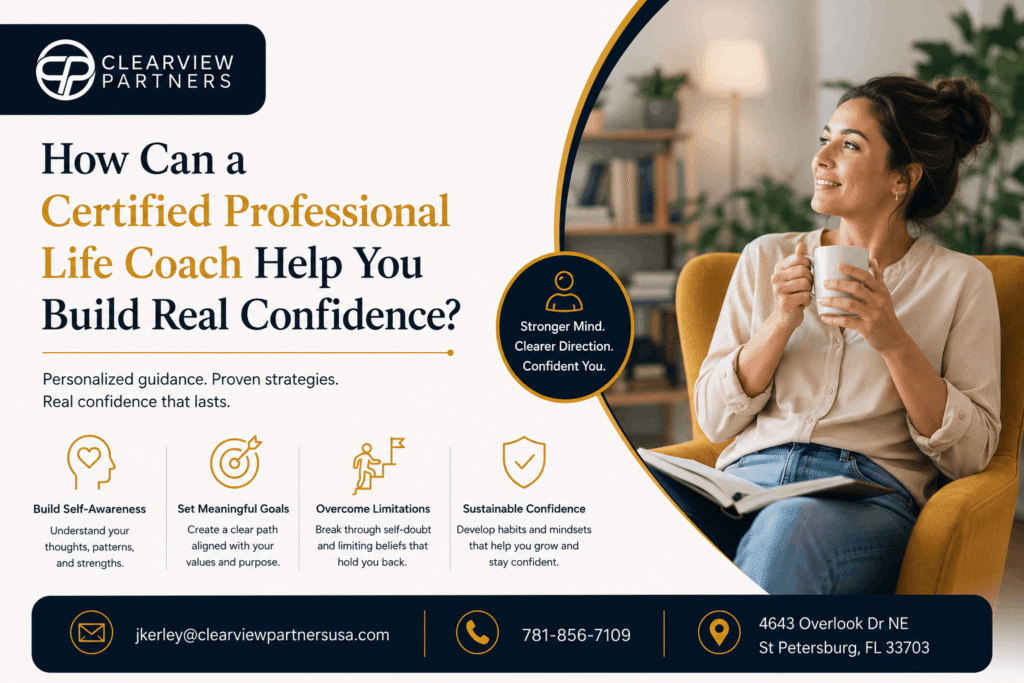
Do you recall a week where everything feels a bit heavier than usual? You try to push through, but your thoughts keep returning to the same concerns. It’s almost like you’ve reached a crossroads where the signs are unclear, and you’re not quite sure which path leads to the version of you that is calmer and genuinely more confident. This moment of searching—when you crave direction and structure—is precisely when collaborating with a certified professional life coach becomes a powerful option. It’s not because you are lost, but because you are ready to stop settling and step into a life that is clearer and more authentically aligned with your deepest desires. The urge to improve often leads people to search specifically for a supportive confidence coach near me. In this blog, we will explore the structured, powerful ways a certified professional life coach helps you build real, lasting inner confidence. When You Hit That Wall and Start Looking for Support There comes a moment when you become aware of the fact that you are getting tired of always being the one to keep everything together. It could be that you are balancing work pressure. And the persistent feeling of “I should have solved this by now.” You attempt to express your thoughts to people who are close to you. But the conversation gets stuck in the same loop. You want guidance, not just solace. You want lucidity, not truisms. This is where a certified professional life coach steps in with real structure and meaningful guidance. Someone who doesn’t brush off your doubts, but helps you untangle them one by one. Why the Right Coach Makes a Noticeable Difference? There’s something steadying about talking to someone trained to understand your thought patterns. A certified coach works with proven methods, but the experience still feels personal… human. They won’t hand you ready-made advice that sounds good. But also doesn’t fit your life. They help you break down what’s actually holding you back. And show you how to move forward in a way that feels natural. You end up thinking clearly and understanding yourself better. And honestly, that alone can feel like a huge relief. How a Certified Professional Life Coach Helps You Build Real Inner Strength? Confidence rarely arrives in one big moment. It usually grows in small steps. These are simple habits and decisions made with less panic and more control. A coach guides you through those shifts. They help you rewrite the stories you’ve been telling yourself. You begin to understand the reasons for the difficulties that come to you harder, the days that are not good, and the ways to create a strong mentality that won’t give up at the first sign of stress. It’s not a matter of acting as if one is very strong. It’s a matter of acquiring the skills to strengthen oneself from within. That kind of inner strength sticks with you in your job, your relationships, your goals… pretty much everywhere. When You Find Yourself Searching “Confidence Coach Near Me” Typing confidence coach near me usually happens when you’re craving change but not sure where to begin. You want someone who understands real-life struggles. A person with whom you will be able to share your innermost feelings without any fear. A life coach demonstrates and upholds this, and at the same time makes use of the methods that really work, so your inspiration lasts more than just one day and you constantly progress in your normal life. Why Coaching Starts Feeling Transformative? Working with the right coach often feels like someone gently rearranging the clutter inside your mind. You start noticing small wins: Maybe a tough conversation doesn’t scare you as much. Maybe decisions come a little easier. Maybe you should stop apologizing for not doing wrong. These are the moments before you realize it. Your confidence starts to feel more natural and less forced. Your Growth Becomes Something You Can Count On You build habits that support you long-term with consistent coaching. You learn how to check in with yourself. How to pause before slipping into old patterns. And how to show up with more purpose. You begin trusting yourself more. You speak with more certainty. You make choices that actually reflect what you want. A certified professional life coach doesn’t just help you feel confident—they help you stay confident. Conclusion: Your Next Step Toward a New You Choosing guidance from a certified professional life coach is choosing tangible progress you can feel. You’re not just adding temporary motivation to your life; you are creating direction, developing emotional strength, and building self-trust that stays with you long-term. This journey is about learning to consistently show up with more purpose, speak with more certainty, and make choices that truly reflect what you want. Clearview Partners USA offers a coaching experience that supports your growth from every angle. Whether you began by typing confidence coach near me or sought a formal, certified professional life coach, our guidance helps you step into a version of yourself that feels clearer, stronger, and genuinely confident. Ready to build unwavering confidence and clarity? Schedule your introductory session with a certified professional life coach today.